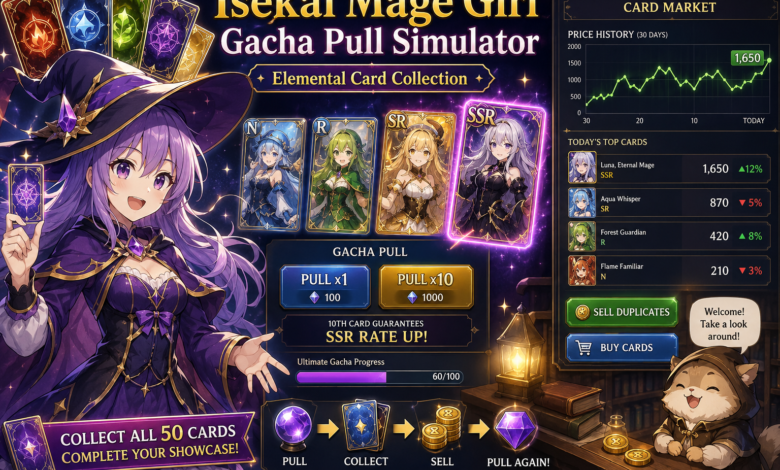
Isekai Mage Girl Gacha Pull Simulator: Elemental Card Collection is an unusual indie simulation game that combines gacha mechanics, card collecting, resource management, and a virtual card-trading market. Developed and published by Violet Soft, the game was released on March 27, 2026, and is available for PC through Steam.
At first glance, the title sounds like a straightforward gacha simulator. However, the game adds another layer to the formula by giving its collectible cards changing prices. Instead of simply pulling cards and filling a collection, players can sell duplicates, watch market charts, purchase previously obtained cards, and try to turn their in-game currency into more opportunities to pull rare cards.
The result is a gameplay loop built around collecting and decision-making rather than traditional combat.
What Is Isekai Mage Girl Gacha Pull Simulator?
Isekai Mage Girl Gacha Pull Simulator: Elemental Card Collection is a single-player game centered on collecting fictional magical-girl cards. The developer describes its basic loop as earning currency, pulling cards, receiving duplicates, selling those duplicates, and using the proceeds to continue collecting.
The game contains 50 collectible cards, with the overall objective being to complete the collection and fill the available showcases.
What makes the game different is that cards are not simply static collectibles. Their in-game selling prices change from day to day. Players therefore have to decide whether to sell a card immediately or hold onto it in the hope that its value increases later.
This combination of gacha collecting and market-style decision-making is the central idea behind the game.
How the Gacha System Works
The gacha system is designed around the excitement of opening pulls and discovering which card appears.
The game features four stated rarity levels:
- N
- R
- SR
- SSR
SSR cards are the rarest tier and are intended to be the most exciting cards to obtain. The game also includes special animations that can indicate when a particularly valuable result is coming.
Players begin with individual pulls, but progression can eventually unlock larger pull options. According to the Steam description, collecting enough cards unlocks a 10-pull gacha, with the tenth card receiving a boosted SSR rate. Further progression unlocks an Ultimate Gacha, where the SSR rate increases with successive 10-pulls.
This creates an incentive to keep collecting and managing resources rather than spending everything immediately.
The Importance of Duplicates
In many collectible games, receiving a duplicate can feel disappointing. Isekai Mage Girl Gacha Pull Simulator takes a different approach.
Duplicates have an economic purpose.
When players obtain a card they already own, they can sell it to the shopkeeper and receive in-game currency. That money can then be used for additional pulls.
This creates a repeating cycle:
Earn → Pull → Collect → Receive duplicates → Sell → Pull again
The system means that even an unwanted duplicate can contribute toward future progress.
Players therefore have to think about their collection as both a set of cards and a source of resources.
Card Prices Change Every Day
The most distinctive feature of the game is arguably its card-price system.
All 50 cards have prices that fluctuate over time. Players can view price history through charts and examine changes over a period of up to 30 days.
This transforms the game from a simple collection simulator into something resembling a small in-game marketplace.
A card that is inexpensive today could become significantly more valuable later. Conversely, a card that looks expensive now could fall in price.
That creates several possible strategies.
A player might decide to sell a card immediately because its price has increased. Another player might hold the same card because they believe its value will continue rising.
The game therefore rewards players who pay attention to market movement rather than automatically selling every duplicate.
Buying Cards Instead of Only Selling Them
The market system works in both directions.
Players can purchase cards they have previously obtained, rather than relying entirely on random gacha pulls. According to the Steam description, previously obtained cards can be repurchased for 120% of their current selling price.
This gives players another method for completing their collection.
Instead of waiting for a particular card to appear through random pulls, players can watch its market value and decide when purchasing it makes sense.
This is particularly interesting for collectors who want to complete all 50 cards.
Learning to Buy Low and Sell High
The game’s market system introduces a basic trading strategy.
Players can study price charts, identify cards that have fallen in value, and purchase them with the hope of selling later at a higher price.
This makes the game different from a conventional gacha simulator because success is not based entirely on luck.
There are still random pulls, but players can also make deliberate economic decisions.
A smart player might divide their resources between gacha pulls and market opportunities. Someone who spends all their currency on pulls may have fewer resources available for attractive card purchases.
Managing that balance becomes an important part of progression.
Earning In-Game Currency
Players need currency to participate in the gacha and market systems.
The game provides three mini-games that allow players to earn money:
- Dishwashing
- Construction site work
- Card sorting
These activities give players a way to rebuild their funds when their wallet becomes empty.
This is useful because the main gameplay loop depends heavily on having enough currency to keep pulling cards and making purchases.
Instead of forcing players to stop when they run out of money, the mini-games provide an alternative route back into the collection cycle.
The 3D Shop Environment
Although the main attraction is the card system, the game also includes a 3D shop environment.
Players can interact with the shopkeeper and arrange collected cards in showcases.
This adds a visual element to the collection process.
Rather than having cards exist only as numbers in a menu, players can display their collection and gradually make the shop feel more complete.
For completion-focused players, filling the showcases provides an additional goal beyond simply obtaining currency.
Completing the Full Collection
The game’s main long-term objective is straightforward: collect all 50 cards.
Completion-focused gameplay can be particularly appealing to players who enjoy collecting systems. Instead of competing against other players, the challenge is to gradually build a complete personal collection.
Because cards have different rarities and prices, completing the set requires a combination of luck, patience, and resource management.
Players may need to decide when to continue pulling, when to sell duplicates, and when to use the market.
Daily SSR Rotation
The game also introduces daily changes to its SSR availability.
According to the developer’s Steam description, available SSR cards rotate daily in sets of five. Players can use an advance day option if they want to target a different SSR selection.
This mechanic gives players another reason to pay attention to the game’s daily cycle.
Instead of having exactly the same rare cards available all the time, the rotating selection encourages players to consider which day might be most useful for their collection goals.
The daily cycle also affects card prices, meaning the market and gacha systems are connected.
No Real-Money Purchases
An important detail for players is that the game uses in-game currency only.
The Steam listing states that there are no real-money purchases or microtransactions. Card trading and price changes are handled entirely through the game’s internal currency system.
This means players are not required to spend additional real money to continue pulling cards after purchasing the game.
The game itself is sold as a one-time purchase, and the developer describes the collection as complete with all 50 cards and no additional content planned.
Characters and Presentation
The game focuses on fictional magical battle girls presented as collectible cards.
The developer also states that the character images were created using AI-generated content.
The visual presentation is designed around the excitement of collecting, with flashy gacha animations and a 3D environment for displaying cards.
For players who primarily enjoy collecting and visual presentation rather than traditional combat, this approach may be one of the game’s main attractions.
Is the Game Multiplayer?
No. The Steam listing identifies single-player as a supported feature.
There is no requirement to compete against other players in real time. The market mechanics are part of the game’s internal simulation rather than a conventional multiplayer trading economy.
This makes the experience more relaxed for players who prefer playing at their own pace.
System Requirements
The listed minimum requirements are relatively modest compared with many modern PC games.
The Steam page lists:
- Operating system: 64-bit Windows 10 or Windows 11
- Processor: Intel Core i5-4690 at 3.5 GHz or AMD Ryzen 5 1500X at 3.7 GHz
- Memory: 8 GB listed on the Steam page
- Graphics: NVIDIA GeForce GTX 750 Ti or AMD Radeon RX 460 with at least 2 GB VRAM
Players should check the official Steam page for the latest requirements before purchasing, particularly because specifications can change with updates.
Languages
The Steam listing currently identifies English, Traditional Chinese, and Japanese interface support.
The game is primarily designed around menus, cards, charts, shop interactions, and collection systems, so language support can be important for players who want to understand market information and progression instructions.
Reception From Players
The game has received Mostly Positive user reviews on Steam. At the time of the available Steam listing, 76% of 26 user reviews were positive.
Community discussions also show interest in the card artwork and collection systems. Some players have suggested expanding the number of card series and adding more collection or display features.
Because the review sample is relatively small, it is better to treat the current rating as an early indication rather than a definitive measure of the game’s long-term reception.
Who Might Enjoy This Game?
Isekai Mage Girl Gacha Pull Simulator: Elemental Card Collection could appeal to players who enjoy:
- Card collecting
- Gacha-style mechanics
- Simulation games
- Resource management
- Virtual marketplaces
- Completing collections
- Strategy based on fluctuating prices
- Casual single-player experiences
- Anime-inspired character designs
It may be less appealing to players looking for a traditional RPG with extensive combat, exploration, or a large narrative campaign.
The core experience is much more focused on collecting, managing resources, watching prices, and chasing rare cards.
Tips for New Players
If you’re starting the game, avoid spending every piece of currency immediately.
First, learn how the economy works. Pay attention to card prices and understand how selling and purchasing affect your available funds.
When you receive duplicates, consider whether selling immediately is worthwhile. If the card’s price has recently increased, selling may provide more currency. If the market is moving in the opposite direction, holding the card may be worth considering.
It is also useful to experiment with the three money-making mini-games so you know how to recover when your funds become low.
Most importantly, remember that the ultimate objective is completing the collection. Every decision should contribute toward obtaining cards you do not already own.
Final Thoughts
Isekai Mage Girl Gacha Pull Simulator: Elemental Card Collection takes the familiar idea of a gacha simulator and adds an unusual economic layer. Instead of simply pulling cards and hoping for rare results, players must manage currency, sell duplicates, monitor changing prices, purchase previously obtained cards, and decide when to take risks.
The combination of 50 collectible cards, daily price fluctuations, market charts, rarity levels, mini-games, 10-pulls, an Ultimate Gacha, and a 3D collection space gives the game a distinctive identity.
For collectors, the appeal comes from completing the set. For strategy-minded players, the fluctuating market creates another layer of decision-making. And for players who simply enjoy the excitement of opening virtual packs, the gacha system provides the game’s central source of suspense.
Released on March 27, 2026, the game is now available on PC through Steam. Its unusual combination of card collecting and simulated market trading makes it an interesting choice for players looking for something different from a conventional gacha or card game.